

News Details
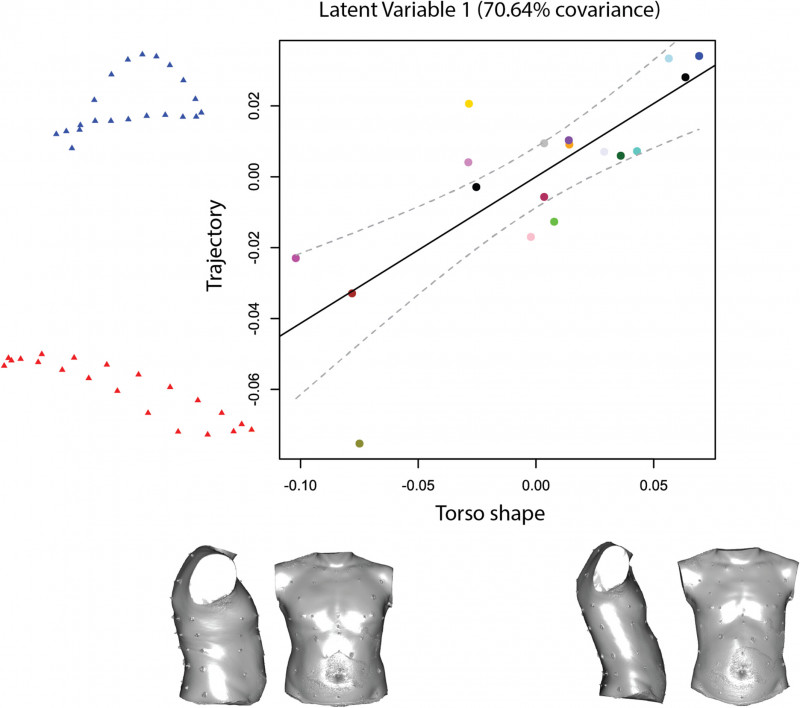
In a recent study published in Methods in Ecology and Evolution, KLI Alumna Marta Gómez-Recio, together with colleagues from Belgium, Italy, and the KLI (Philipp Mitteroecker, Barbara Fischer, and KLI External Faculty Markus Bastir), developed a novel 4D geometric morphometrics (4DGM) workflow to quantify complex biological motion. The method enables separate analysis of shape and motion, offering a significant advance over previous techniques that often conflated the two. Using optoelectronic plethysmography and geometric morphometric analysis, the workflow captures detailed 3D chest-wall configurations over time to examine human breathing kinematics.
The study used this method to analyze breathing at rest and after maximal exercise in healthy males. It also identified distinct breathing patterns associated with body mass index (BMI) and torso shape. For instance, individuals with lower BMI showed a modular breathing pattern with asynchronous thoracic and abdominal movements, whereas those with higher BMI exhibited an integrated pattern. This method has broad applicability beyond respiratory kinematics, enabling the study of morphological change over time, also relevant for evolutionary and ecological questions.
Publication:
Gómez-Recio, M., Bastir, M., Deboeck, G., LoMauro, A., Aliverti, A., Feipel, V., Fischer, B., Mitteroecker, P., & Beyer, B. (2026). A 4D geometric morphometrics workflow to quantify complex biological motion. Methods in Ecology and Evolution, 00, 1–13. https://doi.org/10.1111/2041-210x.70364