

KLI Colloquia are invited research talks of about an hour followed by 30 min discussion. The talks are held in English, open to the public, and offered in hybrid format.
Join via Zoom:
https://us02web.zoom.us/j/5881861923?omn=85945744831
Meeting ID: 588 186 1923
Fall-Winter 2026/27 KLI Colloquium Series
1 October 2026 (Thurs) 3-4:30 PM CET 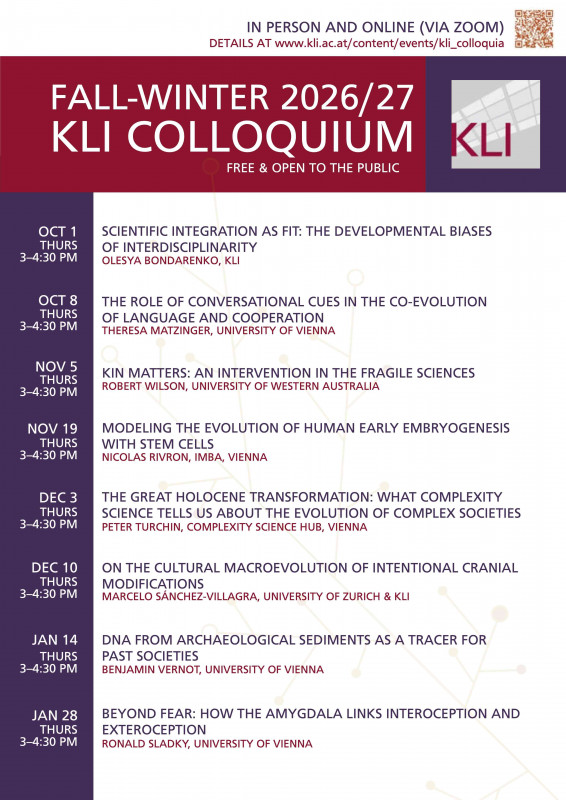
Scientific Integration as Fit: The Developmental Biases of Interdisciplinarity
Olesya BONDARENKO (KLI)
8 October 2026 (Thurs) 3-4:30 PM CET
The Role of Conversational Cues in the Co-Evolution of Language and Cooperation
Theresa MATZINGER (University of Vienna)
5 November 2026 (Thurs) 3-4:30 PM CET
Kin Matters: An Intervention in the Fragile Sciences
Robert A. WILSON (University of Western Australia)
19 November 2026 (Thurs) 3-4:30 PM CET
Modeling the Evolution of Human Early Embryogenesis with Stem Cells
Nicolas RIVRON (Institute of Molecular Biotechnology/IMBA, Vienna)
3 December 2026 (Thurs) 3-4:30 PM CET
Peter TURCHIN (Complexity Science Hub, Vienna)
10 December 2026 (Thurs) 3-4:30 PM CET
On the Cultural Macroevolution of Intentional Cranial Modifications
Marcelo SÁNCHEZ-VILLAGRA (University of Zurich)
14 January 2027 (Thurs) 3-4:30 PM CET
DNA from Archaeological Sediments as a Tracer for Past Societies
Benjamin VERNOT (University of Vienna)
28 January 2027 (Thurs) 3-4:30 PM CET
Beyond Fear: How the Amygdala Links Interoception and Exteroception
Ronald SLADKY (University of Vienna)
KLI Colloquia 2014 – 2026
Event Details

Topic description / abstract:
Unlike the stripes of zebras or the networks of spots found on the coats of cheetahs, the color patterns of butterflies and moths are composed of a limited number of homologous characters that are fully analogous to better known systems of homologs, such as the bones of pentadactyl limbs. This talk will introduce my recent work on the development and evolution of wing patterning in the tiger moths (Lepidoptera, Arctiidae). These animals show an enormous amount of phenotypic variation both within and across species. I will provide some preliminary hypotheses about the genetic and morphogenetic basis of this diversity, and introduce a new theoretical archetype that allows us to make sense of the patterns of the roughly 11,000 existent species of arctiids.
Biographical note:
Richard Gawne is a developmental and evolutionary biologist, currently working as a postdoctoral fellow at the KLI. He holds a PhD in Biology from Duke University. Richard completed his dissertation on the development and evolution of wing patterning in the bella moth Utetheisa ornatrix in 2017, under the supervision of Fred Nijhout. Before coming to the KLI, he was a visiting researcher at the Smithsonian National Museum of Natural History, and a Fulbright fellow at the University of Copenhagen’s Center for Social Evolution.
